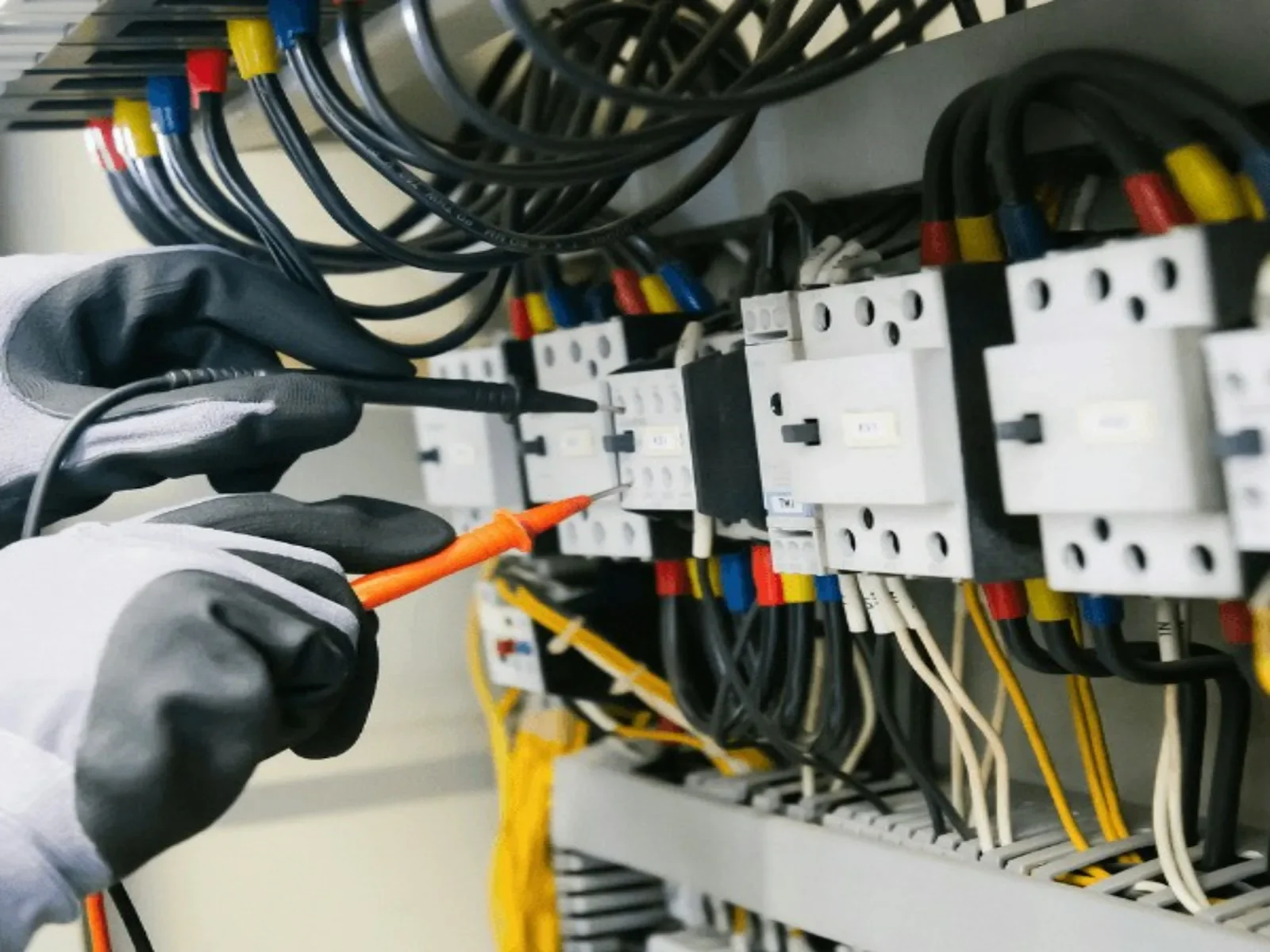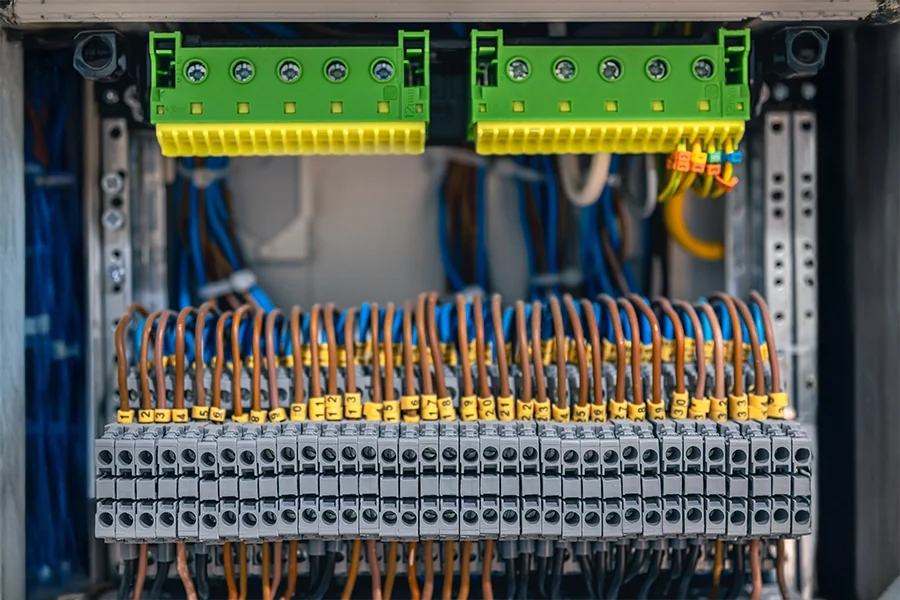
A circuit breaker is a switch that opens automatically when the current in a circuit is dangerous, and can be closed again after the fault is cleared. In low-voltage (LV) panels you will meet five names again and again: MCB, MCCB, RCCB, RCBO and ACB. They are not five brands of the same device. Each does a different job, and a good panel often uses several of them.
Quick answer
- MCB protects final circuits against overload and short circuit, at small currents.
- MCCB does the same at higher currents, usually with adjustable settings.
- RCCB detects earth leakage only; it does not protect against overload or short circuit.
- RCBO combines an MCB and an RCCB in one device.
- ACB is the large air circuit breaker used on main incomers and large feeders.
MCB: miniature circuit breaker
The MCB is the small breaker you see on a DIN rail in a distribution board. It protects lighting, socket and small power circuits. Its trip current is fixed. The trip curve letter (B, C or D in the IEC 60898 style) tells how much instantaneous current it tolerates before tripping; B suits resistive loads, C is common for general use and D for loads with high starting current. Confirm the curve with the designer. The typical rating range is from a few amperes up to about 125 A; check the datasheet of the model you buy. For the board layout see MDB, SMDB and DB panel types.
MCCB: moulded case circuit breaker
The MCCB sits in a moulded case and covers higher currents than an MCB, from tens of amperes to well over a thousand amperes depending on the frame. Many MCCBs let you adjust the overload and short-circuit settings, and some accept add-ons such as shunt trips, auxiliary contacts or motor operators. They are typical on main distribution board outgoings, large motors and sub-main feeders. The full comparison, with a table, is in MCB vs MCCB.
RCCB: residual current circuit breaker
An RCCB compares the current going out and coming back on the live and neutral conductors. If the difference (the residual current) is above its rating, it trips. This detects leakage to earth, for example through a person or damaged insulation. The commonly used sensitivity for protection of people is 30 mA, but confirm the value required for your project with your consultant or the authority.
An RCCB has no overload or short-circuit protection. It must always be installed with an MCB, MCCB or fuse upstream that protects it. This is the key point that many buyers miss when comparing prices.
RCBO: residual current breaker with overcurrent protection
An RCBO does both jobs in one unit: earth-leakage detection plus overload and short-circuit protection. Its advantage is selectivity: a leakage fault trips only the circuit that has it, not a whole group of circuits behind a shared RCCB. It costs more per circuit and takes slightly more space.
ACB: air circuit breaker
The ACB is a large breaker, often withdrawable on rails, built for high currents and high short-circuit levels. It is used on the main incomer of a large board and on bus couplers and large feeders. Most ACBs have an electronic trip unit with a wide range of adjustable settings and can communicate with a monitoring system. Selection needs the system short-circuit level, the incomer rating and the coordination study from the designer.
How to choose
- Load current and cable size: the breaker rating must protect the cable and cover the load. The cables and conduit guide explains what to check on the cable side.
- Short-circuit level at the point of installation: the breaking capacity must be at least equal to it.
- Type of load: lighting, sockets, motors, capacitors, drives. Motor starting current changes the choice of curve or trip unit; see the motor control centre guide.
- Need for earth-leakage protection: and where it should be placed so that one fault does not switch off everything.
- Selectivity (discrimination): the breaker nearest the fault should trip first. This is studied by the designer from the manufacturers' tables.
- Space and wiring: frame size, accessories, terminals; see the busbar guide and the terminal blocks guide.
- Standards and approvals: confirm the requirement for your project with your consultant or the authority.
A simple comparison
| Device | Protects against | Typical place | Adjustable? | |---|---|---|---| | MCB | Overload, short circuit | Final circuits in a DB | No (fixed curve) | | MCCB | Overload, short circuit | MDB/SMDB outgoings, large loads | Often yes | | RCCB | Earth leakage only | Group of circuits, with upstream protection | Sensitivity by model | | RCBO | Earth leakage, overload, short circuit | Individual circuits | No | | ACB | Overload, short circuit | Main incomer, large feeders | Yes (electronic trip) |
Ranges depend on the manufacturer and model, so treat the table as general guidance and check the datasheet.
Common mistakes
- Fitting an RCCB without upstream overcurrent protection.
- Choosing a breaker by current only and forgetting the breaking capacity.
- Using one RCCB for too many circuits, so one fault switches off the whole board.
- Mixing breakers from different makers in one coordinated scheme without checking the manufacturers' selectivity data.
Where Arab Arc Trading fits
Arab Arc Trading in Jeddah works with LV protection and distribution products and panel assembly. See LV Protection and Distribution and Electrical Panel Assemblies. To ask for a quotation, send your breaker list or single line diagram through the contact page.
FAQ
Is an RCCB the same as a circuit breaker?
It switches circuits off, but it protects against leakage only. It needs an overcurrent device before it.
Can I replace an MCB with an MCCB?
Only if the rating, breaking capacity, mounting and the board's design allow it. Ask the designer or the panel builder.
Which breaker is used on the main incomer?
In large boards it is often an ACB or a large MCCB, chosen from the short-circuit level and the incomer rating.