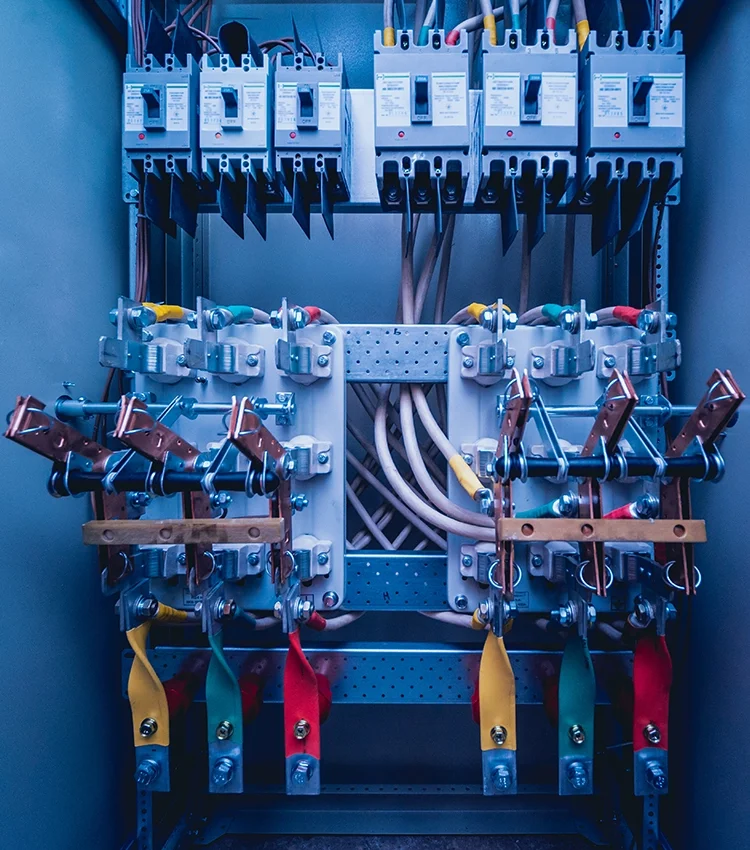
A busbar is a rigid metal conductor, usually copper or aluminium, that carries large currents and shares them between several circuits. You will meet busbars in two places: inside electrical panels, and as busbar trunking that runs along a building in place of heavy cables.

Busbars inside panels
Inside a main distribution board or a motor control centre, busbars form the backbone of the panel. Incoming power lands on the main busbars and the outgoing breakers or starters connect to them. This keeps the layout compact and makes it easier to add or replace outgoing units.
Common terms you will see on a panel specification:
- Main busbar: the horizontal bars that carry the whole board current.
- Vertical (distribution) busbar: the bars that feed the individual outgoing units.
- Neutral and earth bars: separate bars for the neutral and protective earth conductors.
For how the boards themselves are organised, see MDB, SMDB and DB panels and the motor control centre guide.
Busbar trunking
Busbar trunking (also called busway) is a factory-made system of busbars inside a metal housing, supplied in standard lengths with joints, bends and tap-off units. It is used instead of large cables for risers in high-rise buildings, along factory production lines and in data and utility rooms.
| Cables | Busbar trunking | |
|---|---|---|
| Installation | Cut, route and terminate on site | Bolt together factory-made sections |
| Flexibility | Easy to route around obstacles | Changes of direction need the right fittings |
| Adding outlets | New cable run and termination | Plug in a tap-off unit at a designated opening |
| Typical use | Smaller or irregular feeds | Large, repeated or high-current feeds |
Which is better depends on the project: current, route length, number of tap-offs, budget and the consultant's design.
What to check when selecting a busbar system
- Rated current. The continuous current the busbar can carry under the stated conditions. Check the ambient temperature the rating assumes.
- Short-circuit withstand. The busbar and its supports must withstand the prospective fault current at that point. Ask for the rated short-time withstand current and the peak withstand current.
- Material. Copper and aluminium are both used. Copper conducts better per unit of cross section; aluminium is lighter. The choice depends on current, space and cost.
- Insulation and enclosure rating. Consider dust, moisture and the location, and the IP rating that follows.
- Joints and connections. Poor joints heat up. Use the manufacturer's recommended hardware and tightening torque.
- Verification and documentation. Ask which standard the assembly is built and tested to and what test documentation is provided. Confirm the requirement for your project with your consultant or the authority.
- Future capacity. Leave space or spare tap-off points for growth.
Coordinating busbars with breakers
A busbar rating means little unless the devices connected to it are rated to match. The breakers must be able to interrupt the fault current at the busbar. To compare breaker types, read MCB vs MCCB: how to choose.
Where Arab Arc Trading fits
Arab Arc Trading supplies and works on low-voltage protection and distribution equipment and panel assemblies in Jeddah. See LV Protection and Distribution and Electrical Panel Assemblies, or contact us with your load list and single-line diagram.
FAQ
Is a busbar the same as a bus bar? Yes. Both spellings are used; "busbar" is more common in technical documents.
Can copper and aluminium busbars be joined? Joining different metals needs suitable connectors and treatment to avoid corrosion at the joint. Follow the manufacturer's instructions.
Does a busbar need to be insulated? Panel busbars are often shrouded or segregated for safety, and trunking is enclosed. The required arrangement depends on the design and the applicable standard.