Pumps and fans run for long hours, so even a small saving per hour adds up. A variable frequency drive (VFD, also called a variable speed drive) lets the motor run at the speed the process needs instead of full speed all the time. This guide explains why that saves energy, when it does not, and what to check before you ask a supplier for a quote.

Why a VFD saves energy on pumps and fans
For centrifugal pumps and fans, the flow changes roughly in proportion to speed, the pressure changes with the square of speed, and the power changes with the cube of speed (these are the "affinity laws"). In ideal conditions, running at 80% speed needs about half the power of full speed (0.8 x 0.8 x 0.8 is about 0.51). Real systems lose some of this gain, but the direction is clear: a small speed reduction can cut power noticeably.
The usual alternative is to run the motor at full speed and throttle the flow with a valve or a damper. That wastes energy as pressure loss. A VFD removes the waste by slowing the motor itself.
When the saving is small or absent
- Constant flow at full speed. If the pump or fan needs full speed all day, a VFD saves little.
- High static head. Where the pump mostly lifts water against height, speed cannot drop far before flow stops; the cube-law gain is smaller.
- Positive displacement pumps and constant-torque loads (for example conveyors, screw and piston pumps) do not follow the cube law, so the saving is mainly in better process control, not in power.
- Oversized motors lightly loaded may be better served by right-sizing first.
Always ask the designer or supplier to estimate the saving from your own duty profile instead of relying on a general percentage.
What a VFD also gives you
- Soft start and soft stop, which reduces mechanical shock on couplings and pipework, and limits inrush current compared with direct-on-line starting. To compare it with a soft starter, read soft starter vs VFD: how to choose.
- Constant pressure or level control when the VFD is fed from a pressure transmitter or level sensor and uses its built-in PID control.
- Fewer water-hammer events when ramp times are set correctly.
- Protection functions such as overload, phase loss and over-temperature, depending on the model.
What to check before you order
- Motor nameplate data: rated power, voltage, rated current, speed, frequency and number of poles. Size the VFD by motor current, not only by kW.
- Load type: variable torque (centrifugal pump or fan) or constant torque. This affects the drive rating and the overload capacity you need.
- Duty profile: how many hours at which flow. This is the basis of any saving estimate.
- Minimum speed: most motors cool themselves with a shaft fan, so running very slowly for long periods needs a check with the motor maker or a separate cooling fan.
- Control signal: pressure or level sensor, 4-20 mA or other signals, start/stop source, and whether a bypass is needed so the pump can run if the drive is out of service.
- Cable length between drive and motor: long cables may need an output reactor or a dv/dt filter. Ask the drive manufacturer for the maximum length.
- Harmonics and supply: large drives can add harmonics to the supply; ask the supplier whether a line reactor or filter is advised.
- Environment: ambient temperature, dust, humidity and enclosure rating (IP) of the panel. Hot rooms may need extra ventilation or cooling.
- Protection upstream: the breaker and cable for the drive input. Follow the drive manual and see the MCB vs MCCB guide for choosing the breaker type.
- Standards and approvals: confirm the requirement for your project with your consultant or the authority.
For the full sizing steps, see the VFD selection and sizing guide.
Where the VFD is installed
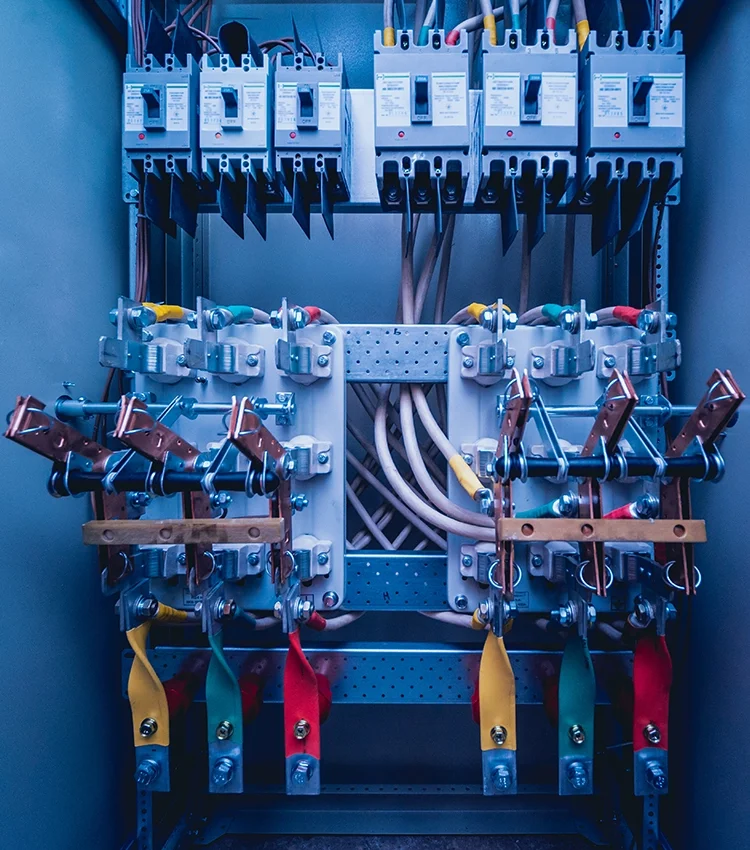
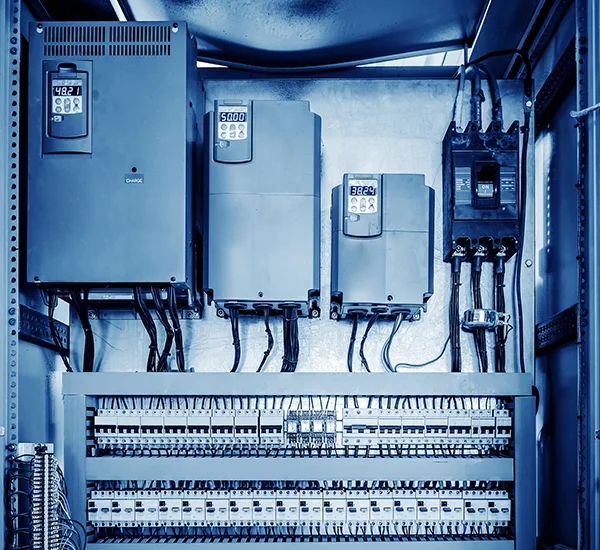
A single pump may have its own VFD inside a small panel. For several motors, the drives sit in a motor control centre with a common busbar; read the motor control centre guide. Control wiring from the field device to the drive ends on terminal blocks; see terminal blocks and DIN rail.
Common mistakes
- Buying by kW only and ignoring the motor current and overload need.
- Setting the minimum speed too low for the motor cooling and the pump's minimum flow.
- Forgetting the sensor and wiring in the bill of quantities.
- Expecting a fixed percentage saving without a duty profile.
- Leaving out a bypass where the pump is critical.
Where Arab Arc Trading fits
Arab Arc Trading supplies motor control products and panels from Jeddah. See Motor Control and Electrical Panel Assemblies, or browse all services. To discuss a pump or fan project, contact us with the motor nameplate data, the load type and the control signal you plan to use.
FAQ
Does a VFD always save energy on a pump?
No. The saving is largest on centrifugal pumps and fans with varying demand. It is small when the load runs at full speed most of the time.
Can I run a VFD on any motor?
Many standard AC induction motors work, but check the motor maker for speed range and insulation limits, especially with long cables.
Do I need a bypass?
For critical pumps it is common to add one, so the motor can run direct-on-line if the drive fails. It is a design decision for your project.
VFD or soft starter for a pump?
If you only need a smooth start and stop, a soft starter may be enough. If you need speed or pressure control, you need a VFD.