Most large buildings and factories run motors, pumps, chillers and lifts. These loads draw current that does useful work and also current that only builds magnetic fields. The second part does not turn into heat or motion, but it still loads cables, transformers and breakers. Power factor correction, usually done with a capacitor bank panel, reduces that wasted current.
Quick answer
- Power factor (PF) is the ratio of real power (kW) to apparent power (kVA). A PF of 1.0 means all the current does useful work.
- Low PF means more current for the same real power. That needs larger cables and transformers and can create extra charges from the utility.
- A capacitor bank supplies the reactive power locally, so less of it is drawn from the network.
- Automatic banks switch capacitor steps in and out as the load changes. A fixed bank suits a single stable load.
- Harmonics matter. With variable frequency drives and similar loads, ask the designer whether detuned reactors are needed.
What power factor means
Electrical loads draw three kinds of power. Real power (kW) does the work. Reactive power (kvar) magnetises motors and transformers. Apparent power (kVA) is what the supply has to carry, and it is the combination of the two. The relation is simple: PF = kW / kVA.
A motor running lightly loaded often has a poor PF. A plant with many motors can therefore have a low overall PF even when every motor is healthy.
Why low power factor is a problem
For the same real power, a lower PF means a higher current. Higher current brings several effects:
- Cables, busbars and breakers carry more current than the useful load needs.
- Transformers and generators are loaded in kVA, so reactive demand uses up capacity that could serve real load.
- Voltage drop and losses increase.
- Some utility tariffs and supply conditions include a power factor requirement or a charge. The rules differ by utility and by contract, so confirm the requirement for your project with your consultant or the authority.
How a capacitor bank corrects it
Inductive loads such as motors need reactive power. A capacitor supplies reactive power of the opposite kind. Placed at the main board, it supplies that demand locally, so the network supplies less of it and the current seen by the incoming cable and transformer falls.
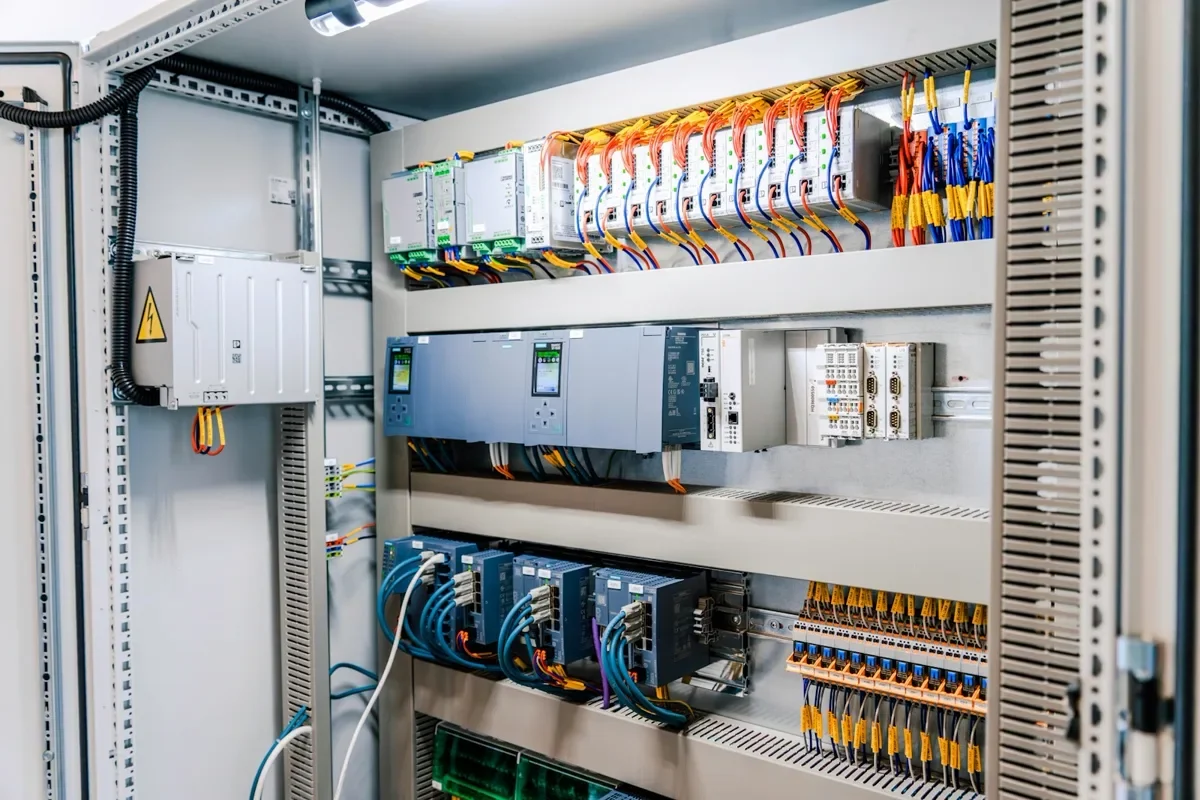
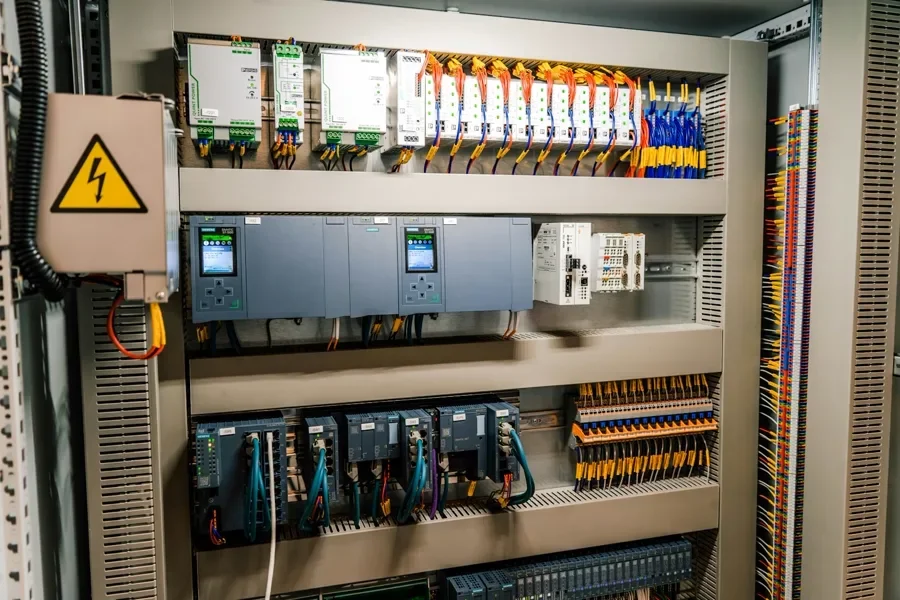
A capacitor bank panel normally contains:
- capacitor units, grouped in steps of different sizes;
- contactors made for capacitor switching, or thyristor switches in fast systems;
- a power factor controller that reads current and voltage and decides which steps to switch;
- protection: fuses or breakers, and often detuning reactors;
- cabinet, busbars and ventilation suited to the heat of the capacitors.
For the incoming board and the way a bank connects to it, see MDB, SMDB and DB panel types and single line diagram for MDB and SMDB.
Fixed or automatic
A fixed bank is always connected. It suits one large motor or a load that is steady all day. If the load drops, a fixed bank can over-correct.
An automatic bank, often called an APFC panel, measures the load and switches steps. This is the usual choice for a main distribution board with mixed loads that change during the day.
Harmonics and detuned reactors
Variable frequency drives, UPS units, LED drivers and other electronic loads create harmonic currents. A plain capacitor bank can interact with the network inductance and amplify those harmonics (resonance), which can damage capacitors. In that case the usual measure is a detuned (reactor-protected) bank. Whether it is needed depends on the harmonic level of the installation. This is a design decision for the consultant or panel designer, not a default. If drives are present, read VFD selection and sizing and mention them in your enquiry.
What you need to size a bank
Send the following and the panel can be specified quickly:
- Supply voltage and frequency, and the transformer rating.
- Real power (kW) and the present PF, from a recent utility bill or a power meter record, and the PF you need to reach.
- The load profile: steady, or changing through the day.
- Whether drives or other harmonic sources are present.
- Installation place (indoor or outdoor), ambient temperature and the space available.
- Any requirement from the consultant or the utility.
The capacitor size is calculated from kW and the change from the present PF to the target PF. Avoid targeting a PF above what the design needs, because over-correction also causes problems.
Common mistakes
- Sizing from the nameplate of a single motor and ignoring the load profile.
- Using a fixed bank on a board where the load swings.
- Ignoring harmonics when drives are present.
- Choosing ordinary contactors that are not rated for capacitor switching.
- Forgetting ventilation: capacitors produce heat.
- Placing the bank before checking the incomer breaker and cable ratings.
Where Arab Arc Trading fits
Arab Arc Trading in Jeddah supplies LV protection and distribution components and coordinates panel assembly. We specify automatic capacitor bank panels around Schneider Electric VarSet banks with Federal Elektrik breakers and TTE enclosures; the details are in the ATS and capacitor bank panels section of the service page. See Electrical Panel Assemblies and LV Protection and Distribution. The related guide for the Jeddah market is electrical panel and switchgear supplier in Jeddah. To request a quotation, send your kW, present PF and single line diagram through the contact page.
FAQ
Can a capacitor bank replace a larger transformer?
It can release capacity by reducing the reactive current, but only your designer can confirm the effect for your installation.
Is a high power factor always better?
Close to 1.0 is the goal, but going beyond what the load needs causes over-correction. Aim for the target set by the design.
Do capacitor banks need maintenance?
Yes. Capacitors, contactors and fans age, so periodic inspection and thermal checks are part of normal practice. Follow the manufacturer's instructions.
Does it help with drives?
Drives often have a good displacement PF at the input, but they create harmonics. Discuss both with the designer.